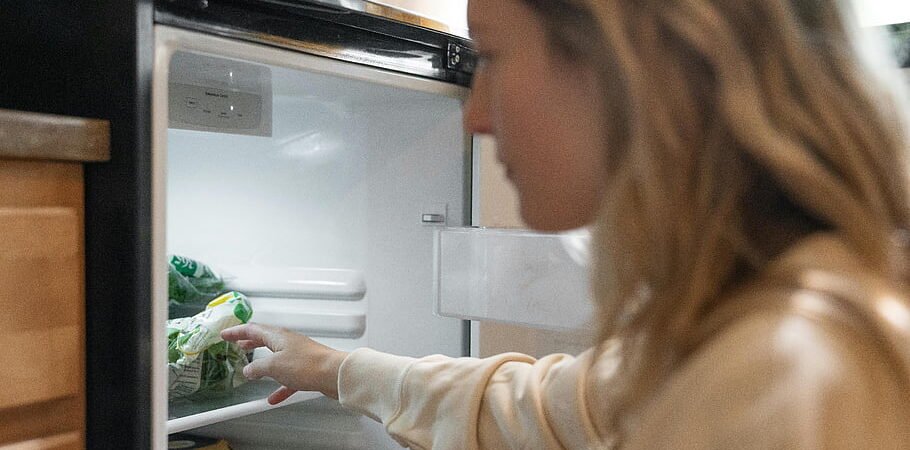
If food in your refrigerator keeps freezing even though it is stored in the fresh-food compartment, the appliance may be running too cold or distributing cold air unevenly.
The cause can be as simple as an incorrect temperature setting, but it may also involve blocked vents, temperature sensors, or control problems.
Here are seven common reasons a refrigerator may freeze food.
1. The Temperature Setting May Be Too Low
Start by checking the refrigerator temperature.
For many refrigerators, around 37°F (3°C) is a common target temperature for the fresh-food compartment.
If the temperature is set too low, food—especially items near the back wall—may begin to freeze.
Try raising the setting slightly and allow several hours for the temperature to stabilize.
2. Food May Be Too Close to an Air Vent
Cold air enters the refrigerator through vents.
Food placed directly in front of these vents may be exposed to very cold air.
Items especially likely to freeze include:
- Leafy vegetables
- Fruit
- Milk
- Eggs
- Bottled drinks
Move food away from vents and leave enough space for air to circulate.
3. The Refrigerator May Be Overloaded
Packing the refrigerator too tightly can interfere with normal airflow.
This may create unusually cold areas near vents and warmer areas elsewhere.
Try to:
- Leave space between food containers
- Avoid blocking vents
- Keep large items away from the back wall
- Avoid overfilling shelves
Balanced airflow helps maintain a more consistent temperature.
4. The Temperature Sensor May Be Faulty
Modern refrigerators use sensors to monitor internal temperature.
If a sensor gives an incorrect reading, the refrigerator may continue cooling even after the correct temperature has been reached.
Possible signs include:
- Food repeatedly freezing
- Temperature fluctuating
- Refrigerator running longer than normal
- Displayed temperature not matching the actual temperature
A faulty sensor may require professional testing or replacement.
5. The Thermostat May Have a Problem
Some refrigerators use a thermostat to control cooling cycles.
If the thermostat is faulty, the compressor may continue running longer than necessary.
This can cause the fresh-food compartment to become too cold.
If adjusting the temperature setting does not change the actual temperature, the thermostat may need inspection.
6. The Damper Control May Be Stuck Open
Some refrigerators use a damper to control how much cold air moves from the freezer into the refrigerator compartment.
If the damper becomes stuck open, too much cold air may enter.
Possible signs include:
- Food freezing near the air vent
- Refrigerator section colder than expected
- Freezer operating normally
- Temperature adjustments having little effect
Damper problems may require professional repair.
7. The Control Board May Be Malfunctioning
The control board manages several refrigerator functions.
If it develops a fault, the refrigerator may cool incorrectly or fail to respond properly to temperature settings.
Control board problems are less common than simple airflow or setting issues, so basic checks should be completed first.
What Should You Check First?
Before arranging service:
- Check the temperature setting
- Move food away from vents
- Avoid overloading shelves
- Make sure air vents are open
- Use a refrigerator thermometer if available
- Monitor whether the temperature changes after adjusting the setting
Where Should You Store Sensitive Foods?
Food that freezes easily should generally be kept away from the coldest areas of the refrigerator.
Avoid placing sensitive foods directly:
- Against the back wall
- Under cold air vents
- In areas where food has frozen before
The exact cold spots vary by refrigerator design.
When Should You Call a Technician?
Consider professional service if:
- Food continues freezing after adjusting the temperature
- The refrigerator runs almost continuously
- Temperature readings are inconsistent
- The thermostat does not respond
- You suspect a sensor or damper problem
- The refrigerator becomes extremely cold
FAQ
Why is food freezing in my refrigerator but not the freezer?
The refrigerator compartment may be receiving too much cold air because of low temperature settings, blocked airflow, or a damper or sensor problem.
What temperature should my refrigerator be?
Around 37°F (3°C) is a common target for many household refrigerators.
Why do vegetables freeze in my refrigerator?
Vegetables may freeze if they are stored too close to a cold air vent or against a very cold back wall.
Can an overfilled refrigerator cause food to freeze?
Yes. Poor airflow can create uneven temperatures and unusually cold areas.
Why does my refrigerator keep getting colder even after I change the setting?
A faulty sensor, thermostat, damper, or control system may prevent the refrigerator from responding normally.
*** If your refrigerator is having the opposite problem and is not staying cold enough, read why your refrigerator is not cooling.
*** If the appliance seems to run almost continuously, see why your refrigerator is running constantly.
*** If the door does not seal properly, read why your refrigerator door is not closing properly.